Choose "Make this ad premium" at checkout.
22.99 Dollar US$ High-Voltage Harmony: Safely Isolating Electric Motorbikes for Maintenance London
- Location: London, London, United Kingdom
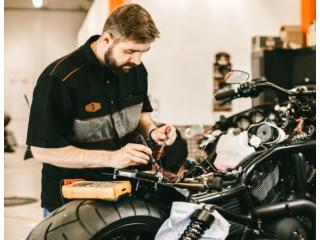
The roar of the combustion engine is increasingly being replaced by the high-frequency hum of electric motors. While this shift toward electrification offers a cleaner, more efficient ride, it introduces a significant new hazard into the workshop: high-voltage (HV) electricity. Unlike traditional motorcycles that rely on a standard $12V$ lead-acid battery, modern electric motorbikes operate on systems ranging from $72V$ to over $400V$ DC. This level of power is more than enough to cause lethal electrical shock or severe arc flash injuries if not handled with absolute precision. For the modern technician, knowing how to safely isolate these systems is the first and most critical step in any mechanical repair.
Whether you are performing a simple brake pad replacement or a more involved suspension tune-up, the proximity to high-voltage orange cabling means that a "safety-first" mindset is mandatory.
The Essential Toolkit: PPE and Insulated Equipment
Before you even approach an electric motorbike with the intent to isolate the high-voltage system, you must be wearing the correct Personal Protective Equipment (PPE). Standard workshop overalls and leather gloves are insufficient. For HV work, you require Class 0 insulated rubber gloves rated for at least $1,000V$, which must be visually inspected and air-tested for punctures before every use. Furthermore, arc-rated face shields and insulated footwear are necessary to protect against the rare but catastrophic event of an arc flash. This specialized gear acts as your last line of defense against the invisible current lurking within the battery pack.
In addition to wearable gear, your workspace must be properly prepared. This involves using insulated hand tools and ensuring the bike is placed on a non-conductive rubber mat. A "Rescue Hook" should always be within reach of a secondary observer—never work on high-voltage systems alone. These safety requirements are a significant departure from traditional petrol-bike maintenance. Transitioning from the world of oil filters and spark plugs to high-voltage isolation requires a structural change in how a technician thinks. Enrolling in amotorbike maintenance course helps bridge this gap, providing the technical vocabulary and safety discipline needed to manage these "silent" dangers effectively.
Step-by-Step: The Isolation and Lock-Out Procedure
The actual process of isolation begins with the "Low Voltage" (LV) system. Most electric bikes use a standard $12V$ circuit to manage the contactors that "close" the high-voltage battery to the rest of the bike. By turning off the ignition and removing the key—and moving it at least 5 meters away from the vehicle to prevent proximity activation—you initiate the shutdown. However, this is not enough. You must then locate and remove the Manual Service Disconnect (MSD) or the high-voltage service plug. This physical break in the circuit ensures that even if the software glitches, electricity cannot flow from the battery to the motor controller.
Once the MSD is removed, you must implement a "Lock-Out, Tag-Out" (LOTO) procedure. This involves placing the MSD in a lockbox or using a dedicated padlock on the battery connector to prevent anyone else from inadvertently re-energizing the system while you are working.
Verifying the "Zero Energy" State
One of the most dangerous myths in electric vehicle repair is that "disconnected" means "safe." High-voltage systems contain large capacitors—components that store electrical energy even after the battery has been isolated. These capacitors can hold a lethal charge for several minutes. Therefore, a "wait time" (typically between 5 and 15 minutes, depending on the manufacturer) is mandatory. After this period, you must verify that the system is truly de-energized using a Category III or IV rated Digital Multimeter (DMM).
The verification process follows a "Test-Test-Test" or "Live-Dead-Live" pattern. First, test your multimeter on a known live $12V$ source to ensure it is functioning. Then, test the high-voltage terminals on the motorbike to confirm a reading of $0V$. Finally, re-test your meter on the $12V$ source again to prove the meter didn't fail during the critical measurement. Only after this triple-verification can the motorbike be considered safe for mechanical repairs. This rigorous attention to detail is what distinguishes a professional technician.


Useful information
- Avoid scams by acting locally or paying with PayPal
- Never pay with Western Union, Moneygram or other anonymous payment services
- Don't buy or sell outside of your country. Don't accept cashier cheques from outside your country
- This site is never involved in any transaction, and does not handle payments, shipping, guarantee transactions, provide escrow services, or offer "buyer protection" or "seller certification"
Related listings
-
 Formatting NGS Results in Pathology Reports: A Modern GuideTutoring - Private Lessons - London (London) - January 26, 2026 21.11 Dollar US$
The introduction of Next-Generation Sequencing (NGS) into clinical pathology has revolutionized the way we diagnose and treat complex diseases, particularly in oncology. However, the sheer volume of data produced by genomic sequencing presents a sign...
-
 Why is "Teacher Autonomy" the Single Biggest Factor in Job Satisfaction for 2026 Educators?Tutoring - Private Lessons - London (London) - January 26, 2026 21.99 Dollar US$
As we navigate the educational landscape of 2026, the traditional hierarchies of schooling are being challenged by a newfound emphasis on professional agency. For years, the conversation around educator retention focused heavily on salary and classro...
-
 Pre Kindergarten Centers Focused on Play-Based EducationTutoring - Private Lessons - Brooklyn (New York) - January 17, 2026 Check with seller
Brooklyn PreSchool of Science offers a safe, engaging environment where young learners grow through hands-on activities, creative play, and guided exploration. Our curriculum supports early cognitive, social, and emotional development while en...